

If you've looked at your solar monitoring data on a sunny day, you may have noticed what seems like an unusual pattern. Rather than continuing to climb toward noon and then gradually decreasing, your production curve reaches a point where it flattens out for a period of time. This phenomenon is called solar clipping.
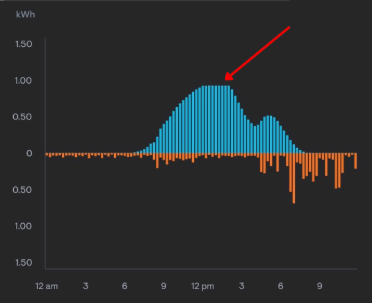
At first glance, clipping can seem counterintuitive. If your solar panels can produce more power, why would your system cap its power output?
The answer lies in a fundamental principle of solar design: systems are optimized for annual energy production and long-term value, not for achieving the highest possible output during a handful of peak hours each year. Let me walk you through it:
1. Solar Systems Are Designed for the Whole Year, Not the Perfect Day
When solar engineers design a solar system, their main goal is to:
- Maximize annual energy generation
- Deliver the strongest financial return
- Balance equipment costs with long-term performance
- Perform efficiently through changing weather and seasonal conditions
In Alberta, that means designing for far more than a few perfect summer afternoons. A well-designed solar system will continue to perform through hazy summer skies, shoulder-season variability, snow-covered winter conditions, low sun angles, and everything in between.
The goal is to create a system that delivers strong production across the full year, even if that means making design choices that may look unusual during short periods of peak sunlight. One of those design outcomes is solar clipping.
2. Why Clipping Is Often Intentional
When designing a solar system, there are two important power ratings to understand: the DC power that the solar panels can produce, and the AC power that the inverter can deliver to the home (or grid).
Solar panels generate direct current (DC) electricity, which is converted into alternating current (AC) electricity by an inverter.
One of the most effective ways to maximize annual energy production is to install a solar array that is slightly larger than the inverter's AC rating (we call this DC oversizing, or DC/AC>1). This design approach allows the system to capture more energy throughout the day and throughout the year, at the expense of some energy during peak production times when the solar panels are producing a little more than what the inverter can handle.
The benefits include:
- Higher production during morning and evening hours
- Better performance during cloudy or hazy conditions
- Increased energy generation during winter months
- Improved overall financial performance
To achieve these benefits, solar designers often accept that the system may experience some clipping during the sunniest periods of the year. In other words, clipping is frequently the result of a deliberate engineering decision rather than a limitation that was overlooked.
If you want a deeper look at how different inverter architectures handle this conversion, we explain the difference between central inverters, optimizers, and microinverters in our guide to Choosing Between Enphase and SolarEdge for Calgary homes.
A healthy DC to AC ratio can range from 1.05 to 1.35 depending on the solar array conditions – mainly shading and orientation, and the type of inverter. Any higher than that and you are likely to start losing too much production due to clipping.
3. The Trade-Off: Losing a Little to Gain More
This is the part that surprises many system owners: reducing clipping doesn’t always lead to a better outcome or better system design.
The easiest way to reduce clipping is to gain more AC capacity – i.e. a larger inverter. A larger inverter may reduce clipping, but the additional energy captured during those brief peak periods can be worth very little relative to the added cost of the inverter, and the overall annual production may actually decrease because the inverter will “wake up” later in the day and “go to sleep” earlier in the day, leading to lost production which is harder to spot on your monitoring app. This has to do with inverter activation voltage, which is essentially how hard the solar panels have to start “pushing” on the inverter to wake it up. In some cases, a larger inverter may not even be an option (electrical constraints, or microinverter capacity)!
Meanwhile, a properly DC-oversized system can deliver optimized production across many more hours of the year, including mornings, evenings, hazy days, and winter conditions.
The result is a trade-off: a small amount of peak production may be clipped, but the system can produce more energy across the rest of the day throughout the year while avoiding unnecessary upgraded equipment costs.
From a design perspective, the goal is not to eliminate clipping entirely. The goal is to find the right balance between panel capacity, inverter capacity, site conditions, equipment options, and long-term value. That balance depends on factors such as shading, roof orientation, solar panel-inverter pairing, electrical capacity, component availability, and future expansion plans.
This is why clipping should not be evaluated in isolation. It should be considered as part of the overall system design and the annual production targets for that specific home.
4. The Bottom Line
Some solar clipping is a normal and intentional result of designing a solar system for annual performance, rather than designing it just to hit the maximum theoretical output available during a few perfect hours of sunlight per summer.
For Alberta homes, a well-designed system should account for the full range of local conditions, including summer haze, winter snow, low sun angles, roof orientation, and shading.
Want to Understand Your Solar Design Better?
Have questions about solar clipping or system performance? Contact Potential Solar to review your solar design, understand your production data, and see what a well-optimized system should look like for your home.
If you’re comparing proposals, our guide to Comparing Solar Quotes can also help you understand whether different system sizes, inverter choices, warranties, and production estimates are truly comparable.